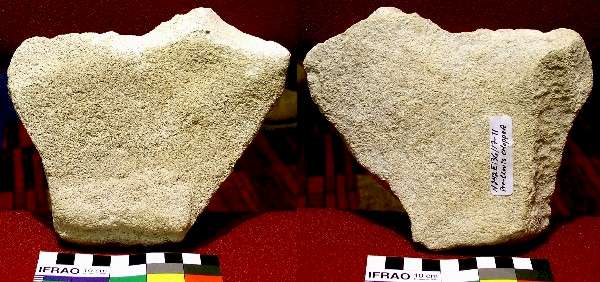
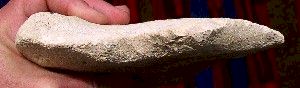
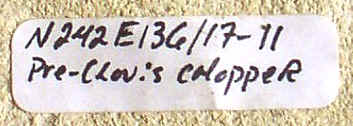
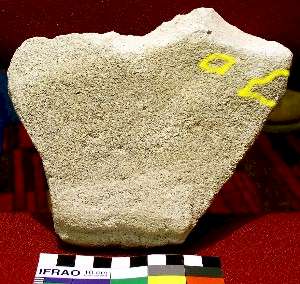
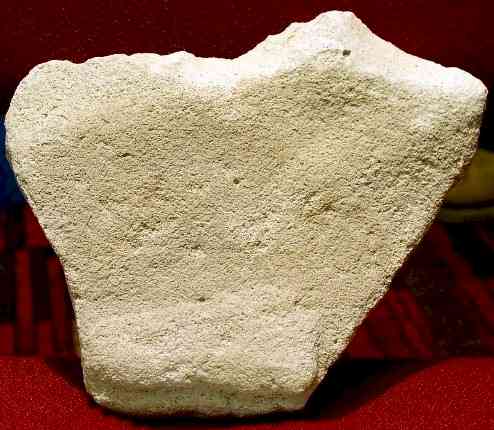
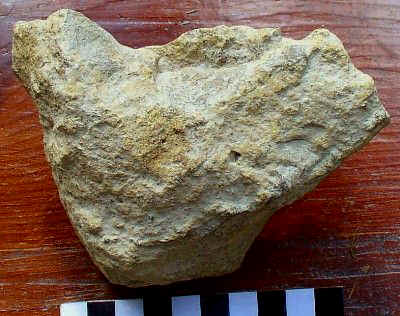
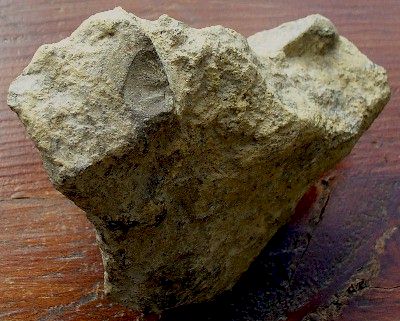
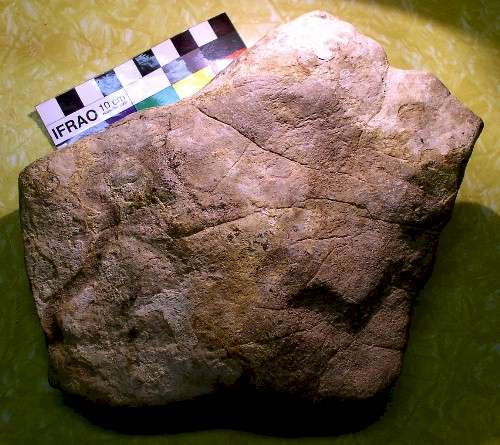
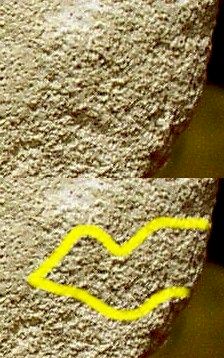
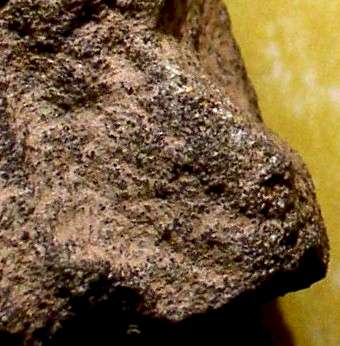
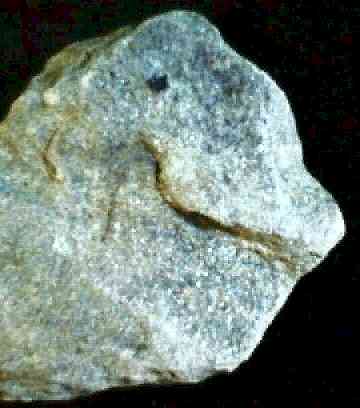
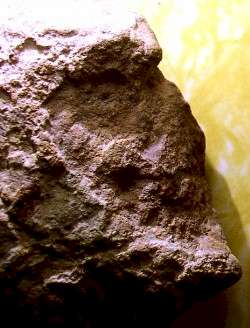
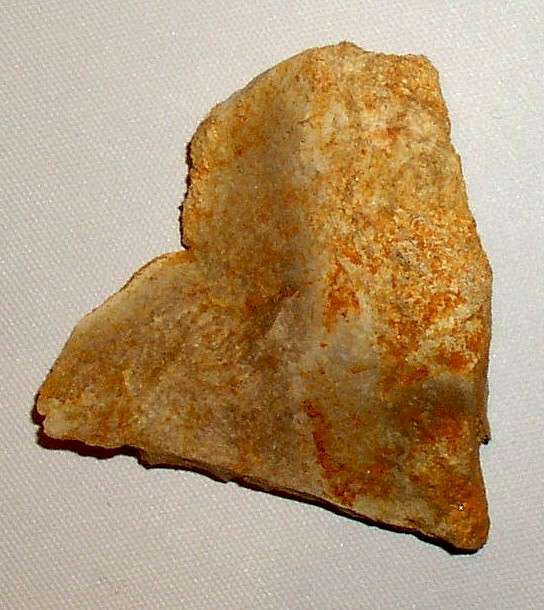
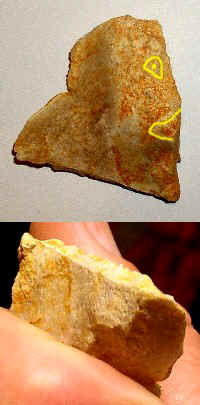
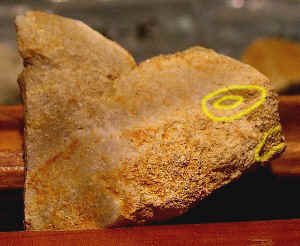
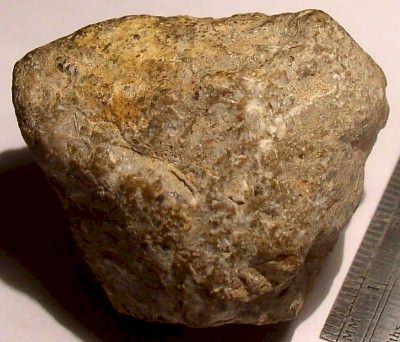
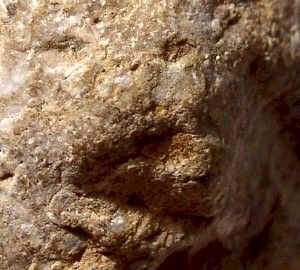
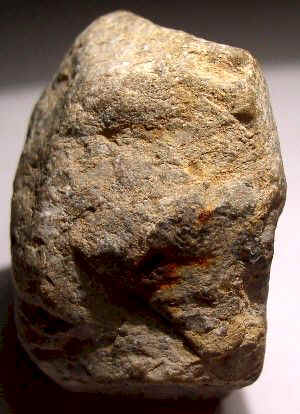
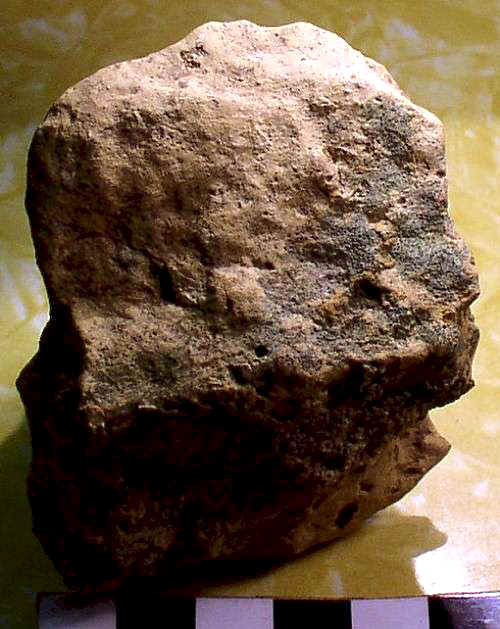
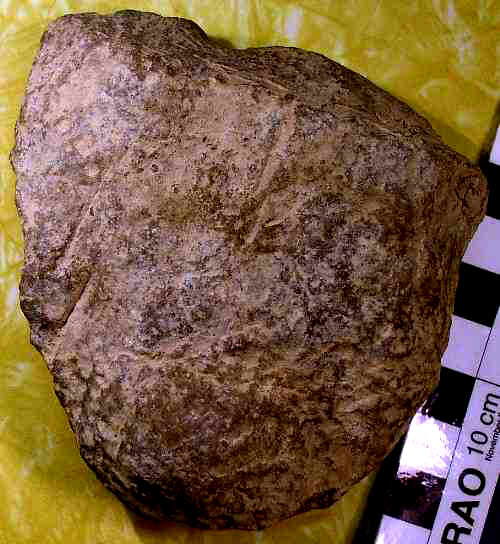
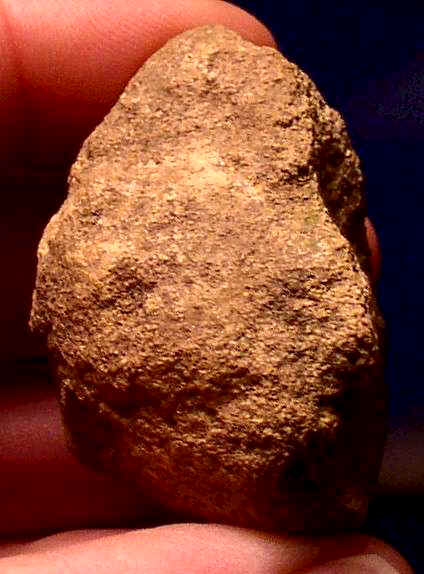
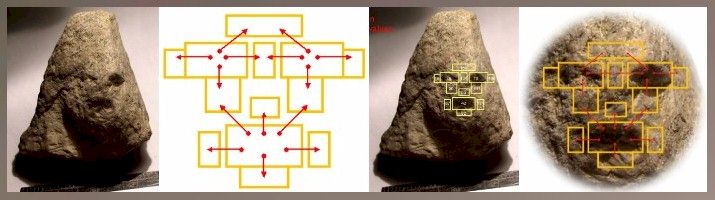
Among the objects from the "pre-Clovis" stratum dated to 16,000-20,000 years BP, this "Topper Chopper" shown above (both sides and the working edge) offers some of the most compelling evidence for human agency. Aside from the bifacial flaking of the edge, and the ergonomic hand grip at the bottom, this simple implement, although badly weathered, still clearly displays the classic zoomorphic features repeatedly appearing in the material first recognized in 1987 at 33GU218 in Ohio and, not surprisingly, many other locations that have since come to light. Note the typical overall abstract bird and/or bear form and, outlined on the photo below, two very characteristic features consistently deeply carved into such figures: a diamond(rhomboid)-shaped eye and a mouth cut in the form of a bird facing inward. It is also significant that the figure incorporates "reflectional symmetry", a hallmark of human agency, in that the image is repeated (although not as distinctly in this case) on the opposite side of the rock. And its flat base allows the figure to stand upright.
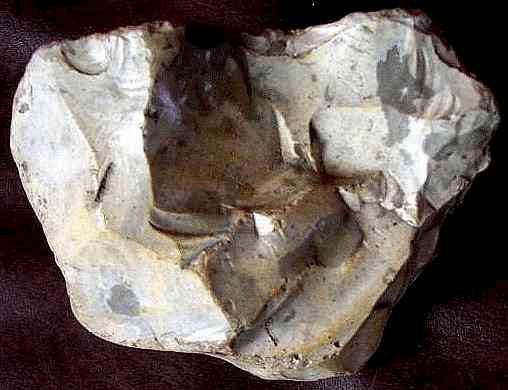
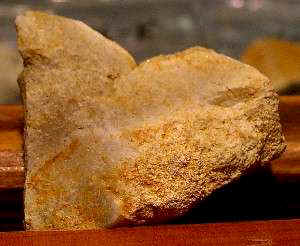
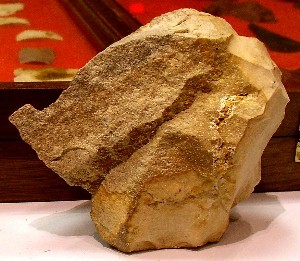
The general form of this stone is a very common one both in North American artifact material and in European artifacts dating from the Paleolithic. For example, consider the Topper Chopper in comparison with this "chopper" (image reversed) from northern France (Abbevillian/Clactonian/Acheulean), very roughly 450,000 years old, from the collection of Charles Belart:
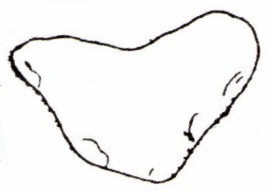
Note that the French chopper (much less weathered) incorporates essentially the same zoomorphic image (including mouth and eye), deriving in part from natural features of the rock opportunistically incorporated into the piece. In the mid-nine- teenth century, the archaeological pioneer Boucher de Perthes identified this general form as prevalent in lithic tools of the Pleistocene in Europe. Here is his drawing:
The three photos below show the same form and zoomorphic imagery in artifacts from 33GU218 in Ohio. The top two are both sides of the same piece. Note both the thematic symmetry and the common "janiform" imagery, a simple zoomorphic head at each end. Temporally diagnostic artifact material (e.g., ceramic and earthwork) in context with the "figure stones" in the upper layer at 33GU218 indicates Early to Middle Woodland age, or quite generally 2000 years BP. Apparently this form of "symbolic behavior" has persisted for a long time, and its presence at Topper in lithic material predating the "Clovis" timeframe is of no little significance.
_________________________ _________________________
____________________ 50,000 Years? ____________________
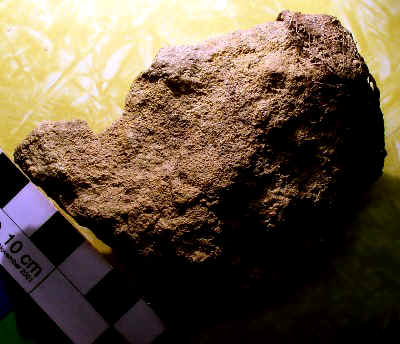
Above: Apparently a simple scraper/pick from Topper, seeming to incorporate the usual imagery, more anthropomorphic in this case. (Note in particular the charac- teristic eye, upper right, and the crest over the forehead.) It is, of course, of no little interest that this object is from a Topper stratum that yielded organic material radiocarbon dated to roughly 50,000 years BP. It will be interesting to see what further exploration at this level produces to provide "replicability". Below: Rotated clockwise, the object shown above incorporates the classic round-faced bird form, the elongated eye being deeply carved into the rock. This is an image that appears constantly and consistently in this evidently very old artifact material. Beneath this, a bird-form pick from 33GU218 in Ohio.
_________________________ _________________________ It has become apparent to this author that the people who created these implements cut the zoomorphic or zoo-anthropomorphic images into them as a matter of routine, however hastily, incorporating both form and function. This author proposed in 2003 that this was the expression of an animistic belief system of ancient and primal origin; essentially the same motifs also appear repeatedly in the Paleolithic artifacts of Europe and other parts of the world. Verification and documentation of chronological stratigraphy at Topper has been meticulous and of the highest quality, and this team has the courage and intellectual integrity to identify and present whatever artifact material appears, whether or not it is consistent with preconceived notions. Dr. Goodyear and his team deserve a lot of credit for their superbly orchestrated "Clovis in the Southeast Conference" in October 2005, and in particular for their uncommon generosity in permitting the attendees, including amateurs like this author, to closely inspect and photograph the oldest artifact material from the Topper site. It was interesting but rather disconcerting to note that the exhibit of Topper's oldest and stratigraphically securely dated artifact material did not attract nearly as much attention as that of well known and often displayed "Indian arrowheads". Many of the professionals queried by this author on the second day of the conference said they "believed" the oldest Topper material to be only naturally formed rocks, but over half of these admitted they had not even briefly looked at it. "Genuine science examines the unexplained. Its fraudulent impersonation 'explains' the unexamined." When the first (very few) photos of Topper's apparently pre-Clovis artifacts were shown publicly, this author noted a possible similarity to those at 33GU218 and other sites. In October 2004, Dr. Albert Goodyear, in a brief conversation with this author, not surprisingly expressed incredulity, saying that he does not see images anywhere that are not "very obvious". Given the skepticism with which the Topper material has been greeted, it does seem reasonable at this point to demonstrate the artificiality of the Topper stones mainly from the simplistic but pre-approved perspective of arrowheads and flint knapping; citing the presence of graven images would likely be about as well received as claiming an association with Babylonians or extraterrestrials. Be this as it may, the presence of zoo-anthropomorphic imagery in much of the Topper material is quite identifiable and quantifiable, down to specific incision marks, as is its similarity to that of simple artifacts from other locations in North America and elsewhere; this is real Paleolithic, no longer quite within the popular "Indian" paradigm to which most American archaeologists currently limit themselves. In the long term, a Paleoarchaeologist that can not (or will not) see simple and subtle iconography in the artifact material is much like an Egyptologist unable to recognize hieroglyphs. The typically rudimentary carved imagery is often an index to a human presence when no other is immediately evident. This certainly is not to suggest a cognitive deficiency on the part of the Topper investigators, but rather an endemic and long-cherished dysfunction in the discipline as a whole. And one must consider the overall risk-averse mindset of American archaeology - someone digging below what is "supposed to" be there is seen as being as foolhardy as a fifteenth century explorer sailing to where the sea was assumed to spill over the edge of the earth. (But why would one even think of not digging deeper?) (As an aside, it is amusing that Dr. Michael Waters, who trumpeted the discovery of pre-Clovis artifacts at the Friedkin site in Texas, and Dr. Michael Collins of Gault fame, had promptly declared the older Topper material to be of natural origin. A recurring theme in pre-Clovis archaeology is "My stuff is real and yours is not!". A professional in this field who had become a bit cynical once commented that American Palaeo archaeology is just high school with rocks. Perhaps this is not all that much of an exaggeration...) _________________________ _________________________
More Photos: Left, pre-Clovis Topper artifacts; right, artifacts from 33GU218 of similar form and incorporated imagery, some subtle, some very clear.
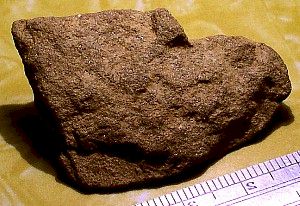
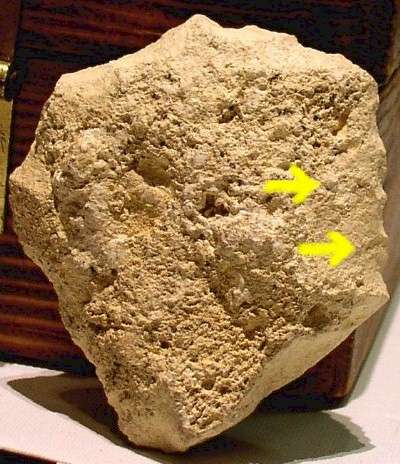
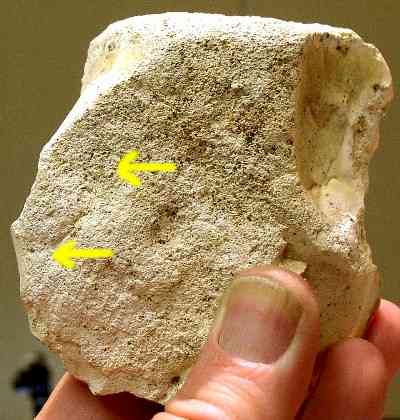
_________________________ _________________________ The photo below shows a heavily weathered but clearly worked chert piece collected by this author at the surface of the quarry area on the gentle slope immediately uphill from the pre-Clovis dig, an area at which the investigators thought the artifacts to be from the Early Archaic Period. It is very light, having lost much of its mass over a long time in this environment apparently adverse to the preservation of the relatively low-quality chert here. (The investigators of the site declared this to be archaeologically uninteresting, so it is now in this author's possession.) As a surface find its temporal association is, of course, uncertain, but it is interesting that it bears an incorporated quasi-anthropomorphic face image characteristic of material from 33GU218 and from other North American archaeological sites. Note the face capped with a quasi-anthropomorphic figure (looking to the right and slightly upward), and the eyes, a feature of this artifact typology that received particular attention to detail.
|